
Almost every day we can face challenges, whereby we may need to make decisions along a continuum of accepting or rejecting risk. For example, choosing whether to speed along an unsealed road, jay-walking across a busy intersection, smoking cigarettes, entering a confined space without conducting a pre-entry gas test or working at heights without any fall protection equipment. The subjective way in which individuals comprehend risks can be known as risk perception.
Risk perception is important because it helps determine which hazards individuals consider to be more or less significant and how they will deal with them. Perceptions of risk are an inherent part of our daily decision-making process. However, risk perception can be a highly personal and subjective, based on an individual’s frame of reference developed over a lifetime.
Have you ever said or heard any of the comments below?
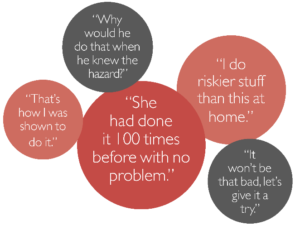 Risk perception influences risk tolerance, which is an individual’s preparedness to accept a certain amount of perceived risk.
So, to make this personal, a good question might be “what is my perception of risk”? Is it ‘the chance of something bad happening’? How realistic is that chance? What is really in place to limit the chance of the bad thing from happening?
This perception and acceptance of risk can be subjective and therefore varies with each individual, using a mixture of experience, cognition (weighing the evidence, using reasoning and logic to reach conclusions) and emotional evaluations (intuition or imagination).
When assessing a risk, you might like to ask yourself:
- What information do I have on this risk?
- What could happen to me, or those around me, if I ignore this risk?
- What is affecting my perception of this risk?
- How else could I assess the risk level?
- What risk tools do I have to assess risk, for example Wellsite Permit to Work or JSEA?
The more an individual is aware of the health and safety risks , the more readily any individual can address and communicate the risks in a meaningful way.